The William Lowell Putnam Mathematical Competition
and the Polya Problem-Solving Seminars 2014
K. Soundararajan ("Sound") and Ravi Vakil
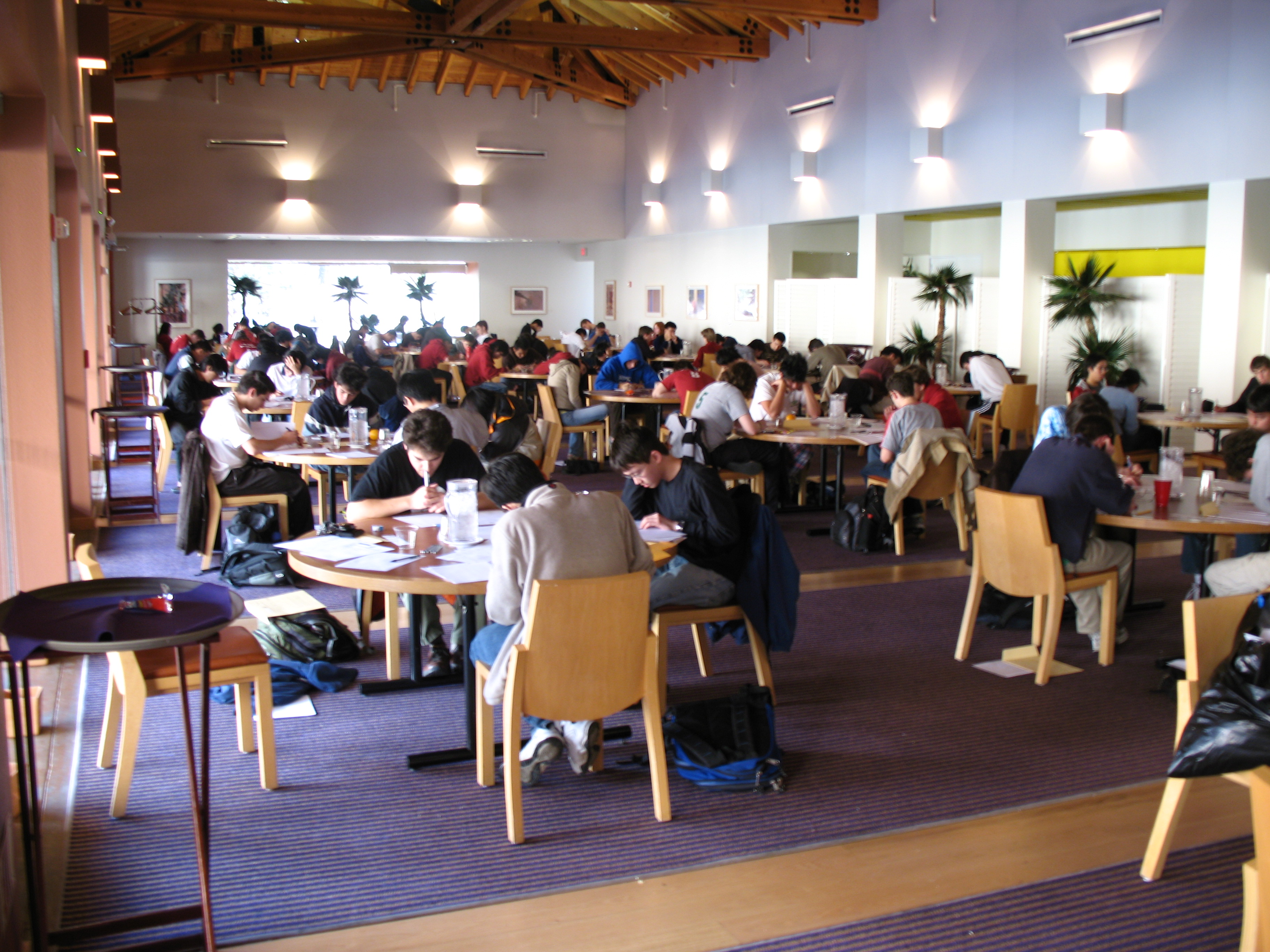
The photo on the right was taken during the 2007 Putnam by Michael
Helms --- it appears with his permission.
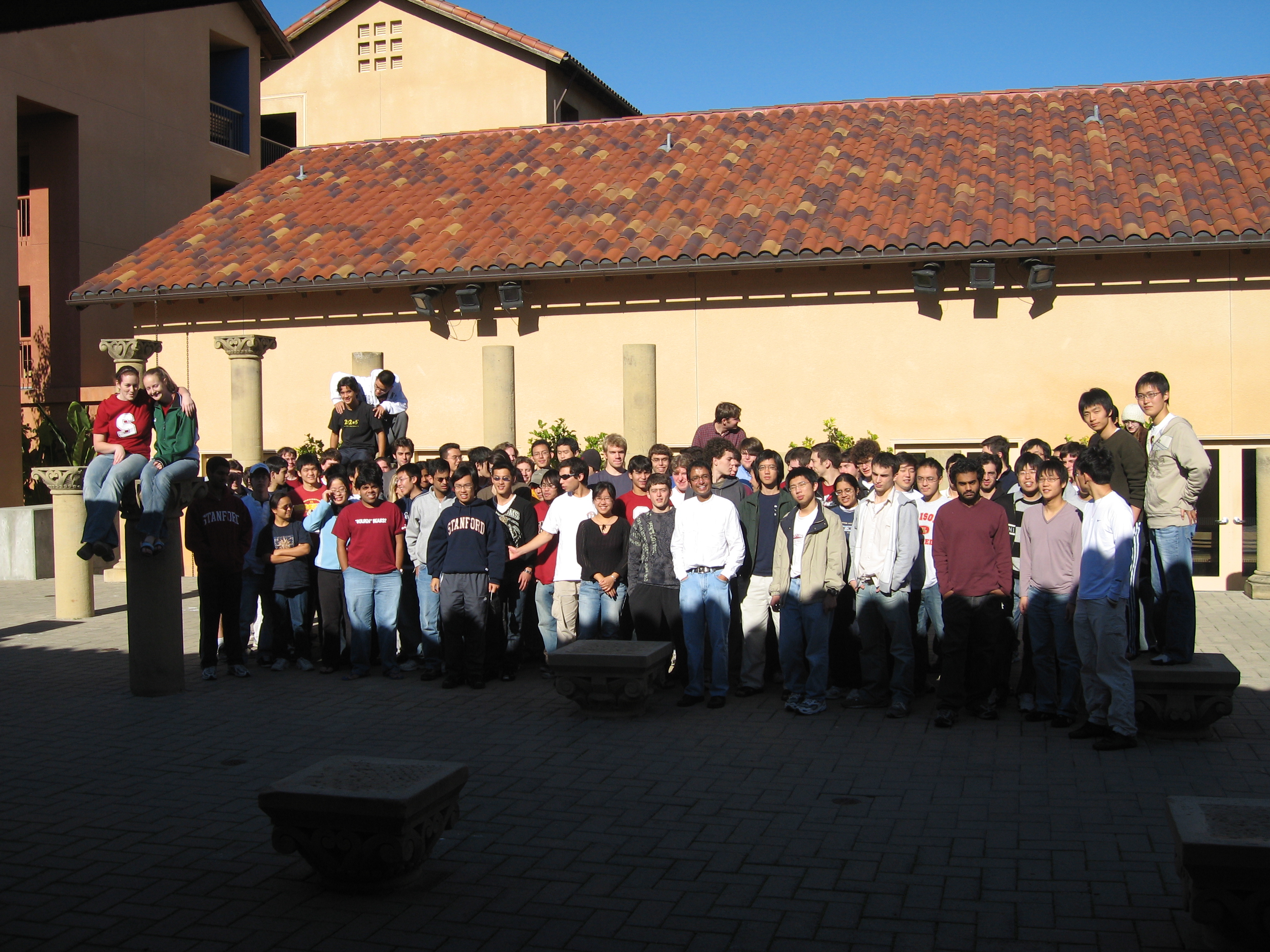
Here is a photo of much of the group before the 2006
afternoon session, thanks to Alex Flury.
The Putnam is a challenging opportunity for you to test your mathematical
mettle. In the 2013 competition, around 4000 individuals participated,
representing over 400 colleges and universities across Canada and the U.S.
The Stanford team placed third,
and many individuals did very well.
The competition emphasizes ingenuity rather than knowledge, so freshmen
are not at much of a disadvantage compared to seniors. Interest in or
experience with problem solving is a plus. Not just math majors
have done well; many recent winners have come from nearby disciplines,
including physics, computer science, and engineering.
Completely solving even one of the twelve problems is a
significant achievement, and in almost all years would place you well
above the median. (Keep in mind that the participants are self-selected
from the best in the continent.)
- UPDATE An introductory meeting, and first meeting of the Polya Problem-Solving Seminar, took place Monday, September 22, at 6 pm, in 380-Y (in the basement of the mathematics department).
Here is the introductory poster.
Here is the introductory handout.
- Meetings: the Polya Problem-Solving Seminars are informal dinner-time problem solving practice
sessions this fall quarter, on Mondays 6:00-8:00. This is the 1 credit course Math 193. You can also sign up on Coursework for Math 193: you don't have to take the course officially; anyone at Stanford can access the materials on Coursework. And if you're not at Stanford, we'll be sure to get everything to you.
(Rough schedule: 5:45-6 beforehand,
people can drop by to discuss ``left-overs'' from the previous week.
6-6:15: short discussion of new technique. 6:15-6:45: eat pizza, work on problems. 6:45-7 eat more pizza, watch ``volunteers'' present solutions and explain
how they thought about the problems.)
Some faculty and graduate students
always turn up with wise words.
Practice problems will include some on the
topics discussed, and some others. Handouts will appear here. UPDATE
- Monday, September 22: general problem-solving strategy, induction,
and the pigeonhole principle. (We start with this every year.) UPDATE
- Monday, September 29: No meeting!
- Monday, October 6: Second meeting.
- We will have one final meeting, a "Putnam post mortem seminar", in January. All twelve
problems will be presented in rapidfire succession.
- The official Putnam website.
- Recommended reading:
- Loren Larson's Problem Solving Through
Problems --- definitely worth
owning. It's great preparation for the Putnam.
- Paul Zeitz' The Art and Craft of Problem Solving.
It is ostensibly aimed at high school students, but there is no sell-by
date on this stuff.
- It is also great help (more than you would think) trying many old problems.
I'd especially recommend the collection of recent Putnams
The
William Lowell Putnam Mathematical Competition 1985-2000: Problems,
Solutions, and Commentary, by Kiran Kedlaya, Bjorn Poonen, and Ravi Vakil.
- There are more good problems in the previous Putnam book,
The William Lowell Putnam Mathematical Competition Problems and Solutions: 1965-1984, by Alexanderson, Klosinski, and Larson (look especially at those
in the 1980's).
Also, on the web you can find
- a compilation of old Putnam problems and solutions UPDATE on the web, collected
by Kiran Kedlaya ---
- to find solutions to older Putnams, you can read
the official solutions in the American Mathematical Monthly, which
you can see electronically
(from any Stanford computer)
here.
At that page, 'Search this journal' for ``William Lowell Putnam''
in the title.
- Some more links are available through this good
UCSD site,
by Patrick Fitzsimmons.
- The 2007 Stanford Putnam website (the last one I maintained).
- Michael Helms has put together this "Hint sheet".
George Polya was perhaps the most famous person to think about understanding
mathematical problem-solving. He was a professor at Stanford.
You can read about him here. (At some point I'll look up how to give him the correct Hungarian accent in html!)
Want more? Additional suggestions for others? Please
let us know!
To Sound's homepage
To Ravi Vakil's homepage